
LaSalle Parish Projected and Actual Release
A projected release date is a current calculation, not a promise that a person will leave through the gate that day. Louisiana DPS&C uses the word “projected” for a reason. Sentence data can change. Credits may be added, lost, or restored. A court may correct the sentence. Another agency may lodge a detainer, which is a request to hold or transfer someone for a separate matter. Even when the sentence reaches its projected end, processing and a receiving authority can affect what happens next.
An actual release record documents the event that occurred. For LaSalle Parish Jail, that may be a booking/release sheet or movement log with the date, time, manner, and destination. For a state-sentenced person, the DPS&C discharge date and status have a different scope. A person can leave the parish jail by transfer to state custody without being released to the community. The projected state date then belongs to DPS&C, not the sheriff’s live roster.
Pretrial detention follows another path. A person awaiting disposition generally has no fixed sentence-release date. Bond may be posted, a judge may order release, charges may be resolved, or another hold may block exit. The LaSalle Parish court record can explain the legal act, while the jail confirms whether physical custody ended.
Find a LaSalle Parish Projected Release
Begin by naming the exact facility and legal authority. LaSalle Parish includes the parish jail, the Olla correctional center and transitional work program, and a federal ICE processing center. A Louisiana state sentence can also be served in a local facility. Each route has a different source, and one search result cannot answer for all of them.
- For a person at LaSalle Parish Jail, ask whether the case is pretrial or sentenced. Use the LPSO jail and Records & Bonds contacts to request the sentence, jail credit, applicable good-time computation, and any known hold.
- For a Louisiana state-sentenced person, use the DPS&C imprisoned-person information route. The verified projected-date service is the telephone locator at 225-383-4580.
- Have the DPS&C number or the exact name and date of birth. Record the date of the call, facility, status wording, projected date, and any sentence-computation referral.
- Check the sentencing judgment and minutes through the LaSalle Parish Clerk of Court. A court document can show sentence terms and jail credit, though it does not replace the corrections computation.
- After the date arrives, confirm actual release, transfer, or continued custody with the jail, DPS&C, receiving agency, or produced discharge record.
The official DPS&C source shown below explains the locator route and the projected-date phone service.
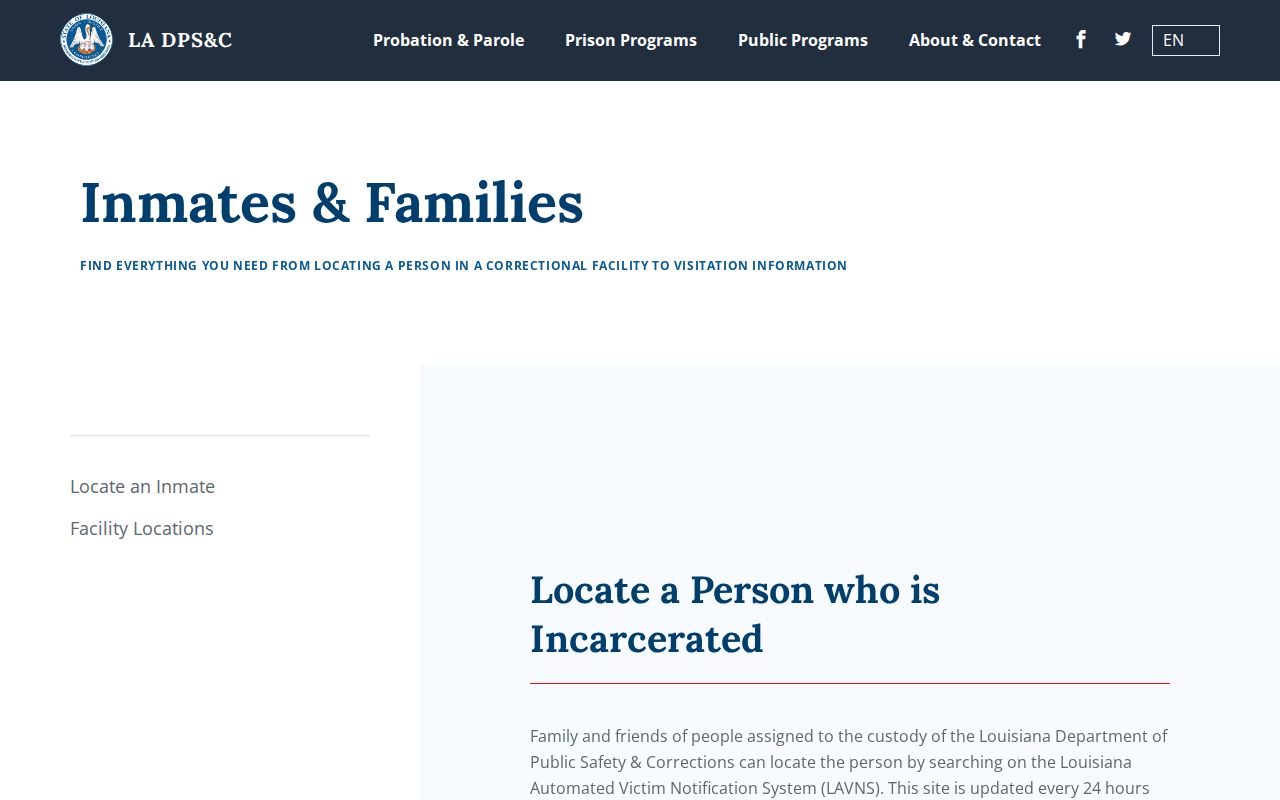
That source is the right starting point for a state sentence, while the LaSalle Parish jail and court remain the right sources for a parish custody episode.
Note: Do not send a sentence-calculation dispute to the general public-record email when DPS&C directs computation questions to a separate channel.
LaSalle Parish Release Date Sources
The same person can pass through several systems. Search scope matters more than convenience. The sheriff controls a parish jail movement record. Louisiana DPS&C controls a state sentence computation. BOP controls federal prison dates. ICE controls civil immigration detention, where leaving a Jena facility may mean release, transfer, or removal rather than a sentence discharge.
| Custody or sentence | Best projected-date source | Best actual-event proof |
|---|---|---|
| Pretrial LaSalle Parish Jail case | Court and jail status; often no fixed date | Jail release or movement record |
| Sentenced parish prisoner | Jail computation and sentencing record | Jail release sheet or destination entry |
| Louisiana state sentence | DPS&C locator and computation route | DPS&C status or produced discharge date |
| Federal BOP sentence | BOP Inmate Locator | Past BOP release date, scoped to BOP custody |
| ICE detention in Jena | No criminal sentence projection; use ICE case channels | ICE/ERO confirmation or custody-history record |
La Salle Correctional Center and Transitional Work Program requires one extra classification step. Ask whether the person is a parish prisoner, a state-sentenced person housed locally, or in transitional placement. The answer determines whether the facility’s movement record or the DPS&C computation is controlling. No official public recent-release archive was found for that center.
Federal custody needs the same discipline. A past date in the BOP Inmate Locator can establish the end of BOP custody, but it does not rule out state, local, immigration, or supervised custody afterward. The Central Louisiana ICE Processing Center is different again. ICE’s locator is built to find people in current civil detention, not to calculate a criminal sentence date. A missing ICE result may reflect release, transfer, removal, a data delay, or a search mismatch. Follow up with the facility or ERO instead of assigning a projected community-release date.
When records conflict, compare their agency and timestamp. The sheriff can accurately report that someone left LaSalle Parish Jail while DPS&C accurately reports continued incarceration elsewhere. A court can accurately authorize release while physical processing is still underway. State the narrow fact each source proves, then obtain the event record from the system that controlled the next step.
LaSalle Parish Good-Time Computation
Louisiana release calculation depends on the offense date, conviction and sentence, sentence structure, time credited before sentence, statutory eligibility, and credit history. There is no sound one-line calculator for all cases. A sentence for an offense before August 1, 2024 can fall under one of several regimes in R.S. 15:571.3. The research notes that a qualifying parish sentence without hard labor generally uses the statute’s stated diminution rule, while crimes of violence, DPS&C felony custody, and excluded cases follow different terms.
Diminution means a lawful reduction of time to be served through earned credit. It is not the same as parole. The sheriff or superintendent has the role set by statute for qualifying parish prisoners. For a LaSalle Parish sentence, ask which version and provision were applied. Request the computation rather than estimating from the imposed term alone.
Program credits can also matter in eligible circumstances under R.S. 15:828, but no fixed reduction should be promised. Credit forfeiture and possible restoration are addressed in R.S. 15:571.4. This means two people with sentences of the same length can have different projections because the legally material facts differ.
- Jail credit
- Time credited toward the sentence, often for qualifying pre-sentence custody.
- Diminution
- A statutory reduction in time based on the governing eligibility and credit rules.
- Consecutive sentence
- A sentence served after another sentence rather than at the same time.
- Detainer
- A request or notice from another authority that can lead to continued custody or transfer.
LaSalle Parish 85 Percent Rule
The phrase “serve 85 percent” is often repeated too broadly. Louisiana’s current rule is date-sensitive. For eligible felony offenses committed on or after August 1, 2024, R.S. 15:571.3.1 caps ordinary good-time reduction under that provision at 15 percent of the imposed sentence. That cap means at least 85 percent is served for that eligible date cohort under the cited rule. It is not a universal statement for every Louisiana prisoner or every release mechanism.
Exclusions and added rules matter. Sex-offense and habitual-offender provisions can change eligibility. Pre-sentence credit and separate earned-credit provisions may also apply. An offense committed before the effective date must be checked under the earlier framework instead of being forced into the new percentage.
Parole eligibility is separate. R.S. 15:574.4 contains offense- and date-specific categories, including general percentages identified in the research for certain nonviolent, first violence, specified repeat violence, and sex-offense cases, plus many exceptions and ineligible groups. A parole-eligibility fraction does not by itself produce an actual release date. A hearing, ruling, release processing, and unresolved holds can all remain.
Why LaSalle Parish Release Dates Change
A projected date reflects the data and rules in effect when it is calculated. It may move forward or backward. Ask the agency to state the current date and the reason for a change, especially when a previously reported date has passed. A stale screenshot is weaker than a current computation or an event-bearing release record.
| Factor | Possible effect | Verification source |
|---|---|---|
| Corrected jail credit | Changes time credited before or during the sentence | Judgment, minutes, and official computation |
| Earned or program credit | May reduce time when eligibility and completion rules are met | Jail or DPS&C computation |
| Credit forfeiture or restoration | Can move the projection later or earlier | Corrections record and applicable statute |
| Consecutive sentence | Adds another sentence period in sequence | Sentencing judgments and computation |
| Detainer or hold | May lead to transfer or continued custody after one term ends | Holding and receiving agencies |
| Court correction or new order | Can alter sentence structure or credit | LaSalle Parish court record |
| Parole action | Can create a conditional release path, but not a guaranteed gate time | Committee ruling and DPS&C status |
Escape, revocation, and discipline can also affect the calculation. So can data timing. If the DPS&C projected date passes with no visible discharge, call the locator and follow the sentence-computation route. If the person no longer appears after full discharge, request the public discharge date under R.S. 15:574.12(G).
Note: A projected date that has passed is a reason to verify, not automatic proof that the person left custody.
Confirm LaSalle Parish Actual Release
Notification can help track a pending change, but it is not the same as the final release record. The LaSalle Parish LAVNS roster can show participating agency information, and Louisiana publishes a separate Victim Outreach route for formal notice of projected and actual state-prison release. A delivered alert confirms that an agency sent an event to the system. It may not state the exit door, receiving agency, or exact court basis.
For a state-sentenced person, use the current status, call the DPS&C locator, and seek the discharge date when needed. For LaSalle Parish Jail, request the movement or release sheet with exact date, time, manner, and destination. If the record says transfer, follow the receiving system. The parish roster no longer controls once another agency takes custody.
The LaSalle Parish VINELink inmate search explains the person-specific registration path. Keep notification details private, and never expose a PIN or private contact address in a saved screenshot.
A strong conclusion is narrow: “left LaSalle Parish Jail by transfer,” “discharged from Louisiana DPS&C,” or “released from BOP custody.” Each phrase names the system that the evidence actually proves.