
LaSalle Parish Three-Day Release Status
Some agencies expose a vendor tab that keeps recently released names for a fixed rolling period. LaSalle Parish does not. Research found no 72-hour release view on the sheriff website, in the OCV web manifest, on the parish LAVNS page, or among the reviewed mobile-app features. There is also no published cadence or retention rule for a feed that does not exist.
The available online sources are the LaSalle LAVNS current roster and the LPSO inmate search. Both can establish a starting lead. Neither can be backdated into a three-day ledger. Collecting names that vanish between snapshots would also be unreliable because a disappearance can mean transfer, a corrected entry, or a different refresh time.
Check LaSalle Parish Three-Day Releases
Set the period before searching. A rolling 72-hour window begins at the exact current time, while a three-calendar-day request may begin at midnight. State which one is needed. That small choice prevents an event near the boundary from being omitted or counted twice.
- Write the beginning and ending date and time for the LaSalle Parish release window.
- Check both official current rosters and note each source's visible update time. Use names only as leads.
- Call the Jail at 318-992-7358 with the full name, birth date or inmate ID if known, and booking period.
- Ask whether the person left LaSalle Parish Jail within the stated window, the exact time and manner, and whether a receiving agency is recorded.
- Contact Records & Bonds at 318-992-6976 for the booking/release sheet, jail register, or movement history.
- Use the LaSalle Parish Clerk's criminal minutes to identify the bond, dismissal, sentence, or order behind the exit.
For activity limited to the current day, the Jail Releases: 24 Hours workflow uses a tighter cutoff. It still requires the same agency confirmation because no same-day feed exists.
LaSalle Parish Three-Day Record Fields
A valid three-day result needs an event record for each person, not just a name. Request fields that define the custody episode and the next status. If a code appears without an explanation, ask the custodian for the legend.
| Requested field | Why it matters |
|---|---|
| Name and identifier | Matches the person to the right booking episode. |
| Booking number | Separates the event from an older LaSalle Parish arrest. |
| Release date and time | Places the exit inside or outside the chosen 72-hour window. |
| Release manner or authority | Distinguishes bond, court order, time served, completion, or another basis. |
| Destination or receiving agency | Shows whether the exit led to the community or another custody system. |
| Facility | Prevents confusion with the Olla center or Central Louisiana ICE Processing Center. |
A court order can precede the physical exit because the jail still must process the release and check for holds. The jail event time and court act should be kept side by side. One explains physical movement; the other explains legal authority.
LaSalle Parish Weekend Release Checks
A three-day span is useful after a weekend because it reduces dependence on one snapshot. It does not create records that the sheriff never published. Research found no official LaSalle release-hour schedule, holiday posting practice, public pickup zone, or stated property-return procedure. Those details must be confirmed with the jail for the specific event.
Use exact timestamps around the boundary. A Friday court order may be followed by later jail processing. Another hold may prevent community exit altogether. Conversely, a roster checked Monday may no longer display a person who left on Saturday, without showing the day or destination. Request the event date and time instead of assigning the roster-check time to the release.
Note: A court order authorizes action, while the LaSalle Parish jail movement record documents when that action reached the custody system.
LaSalle Parish Multi-System Fallback
After jail and records contact, follow the destination. If staff identifies a transfer to Louisiana DPS&C, search LAVNS or call the state locator with the DPS&C number, or with the name and date of birth. The state search covers imprisonment and community supervision, while a fully discharged result may not stay visible forever. If the person is no longer retained online, a request for the statutory discharge date is stronger.
A parish LAVNS event can corroborate a change sent by the reporting agency. It may not provide the exit door, receiving authority, or exact court basis. Federal and immigration custody require their own systems. BOP covers federal prison, not ICE civil detention. ICE's locator can omit a person who was released or transferred, so a no-result needs facility or ERO follow-up.
The LaSalle Parish released-inmate search organizes those named-person routes. For a three-day list, apply them only to people tied to verified local custody episodes rather than producing an unsupported public roll.
Timestamp LaSalle Parish Release Sources
LaSalle's current-custody tools do not share one public refresh promise. The LAVNS roster shows a visible update indicator. Sampled OCV data looked older and contained current IN records rather than released entries. The sample included inmate identifiers, booked date and time, descriptors, agency fields, and image URLs, but no release date, release reason, or observed OUT record.
This is not proof of a fixed lag. It is a reason to preserve each screen's source, displayed update time, and lookup time. Three daily snapshots without those facts cannot support a three-day release claim. The better evidence ladder starts with a custodian-produced movement record, then uses a contemporaneous notification or locator event as corroboration.
The official OCV feed screenshot shows why its fields should be read as current-custody data.
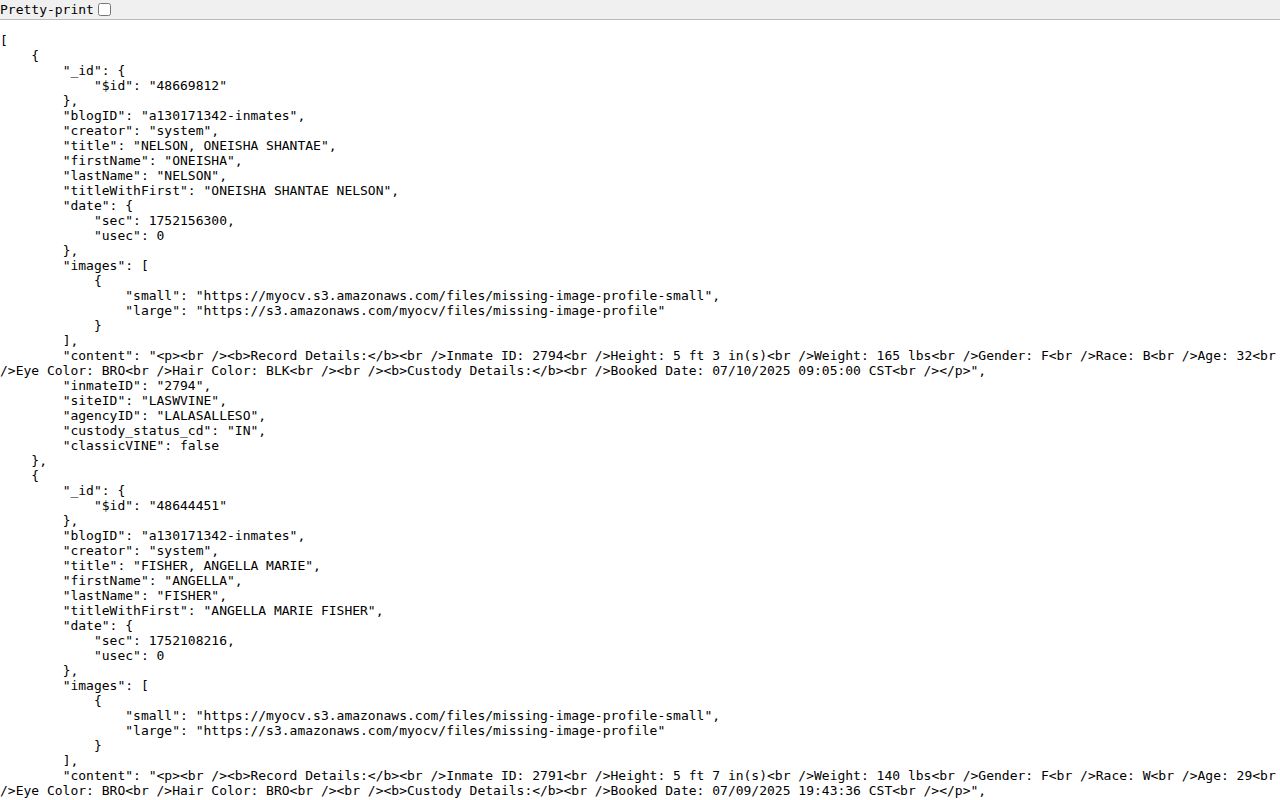
It supports a lead for verification, not a retained list of everyone released across the prior three days.
Read LaSalle Release Outcomes Narrowly
A parish-jail “release” can be an administrative exit without freedom in the community. The record may show bond, recognizance, time served, a court order, completion of a local sentence, transfer, or pickup on a detainer. A detainer is an authority or request for another agency to assume custody. Each label needs a different follow-up.
When the receiving system is named, carry the same identifiers into that system. DPS&C controls a state-sentenced person even if the person had been housed in a parish facility. Another parish controls its own jail record. ICE controls civil immigration detention at the Jena facility, and the parish roster cannot answer that custody question.
A careful result states only what was proved: “left LaSalle Parish Jail on the recorded date by transfer,” “released to the community on bond,” or “discharged from DPS&C.” This keeps the chronology accurate when more than one agency appears.
Build a worksheet for the whole span. Record each person's exact name, booking number, last known facility, source, source update time, lookup time, and the response from the custodian. A single row should never combine two booking episodes. If the same person entered and left custody more than once, treat each episode as a separate event with its own date range and authority.
Direct records also resolve false matches. A common name on Monday's roster may not be the person seen Friday. An inmate identifier or booking number ties the observation to the right case. When no identifier is visible, compare the agency, booked date, and court docket before drawing a conclusion. Ask for aliases only where the agency may lawfully provide them.
The strongest proof is a certified or custodian-produced release or movement record naming the person, booking, date and time, manner, and destination. A VINE event is useful support. A court order proves the legal act but may precede processing. Current-roster absence remains the weakest official lead because it records no exit event at all.
For a written request, state the precise 72-hour period and ask for native electronic records when available. Ask whether a narrower field list or redaction can resolve an exemption. If an agency denies a field, request the legal basis and keep that response with the final timeline. Unknown information should remain unknown rather than being filled from another parish's practice.
Do not count weekly arrest posts as release events. They document an earlier stage of the case and may remain visible after custody changes. Likewise, a photo or old booking entry cannot establish the time or manner of exit. The three-day list should contain only events that the releasing custodian, a matching notification, or another event-bearing official record can tie to the selected period.
Public Record Search
Sponsored Results